New
A new look
A calmer, easier to read design across the site and your dashboard.
Google has watermarked Gemini app text with SynthID since 2024. Here is how it works, what Google itself says weakens it, and what you can and can’t check.
By RealWrite Editorial Team4 min read
Yes. Since May 2024, Google has marked text from the Gemini app and Gemini on the web with SynthID, an invisible watermark built into the words the model picks. Google DeepMind announced it together with watermarking for Veo video, and later published the method in Nature and released an open-source version. Google is also unusually frank about the limits: in its own words, SynthID's confidence "can be greatly reduced when an AI-generated text is thoroughly rewritten or translated to another language".
This article covers what SynthID for text is, where it applies, what weakens it, and why you can't check Gemini text for it yourself.
SynthID started as a watermark for AI images and grew into a family of techniques for images, audio, video and text. The text version works differently from the others, because there is no image to hide anything in.
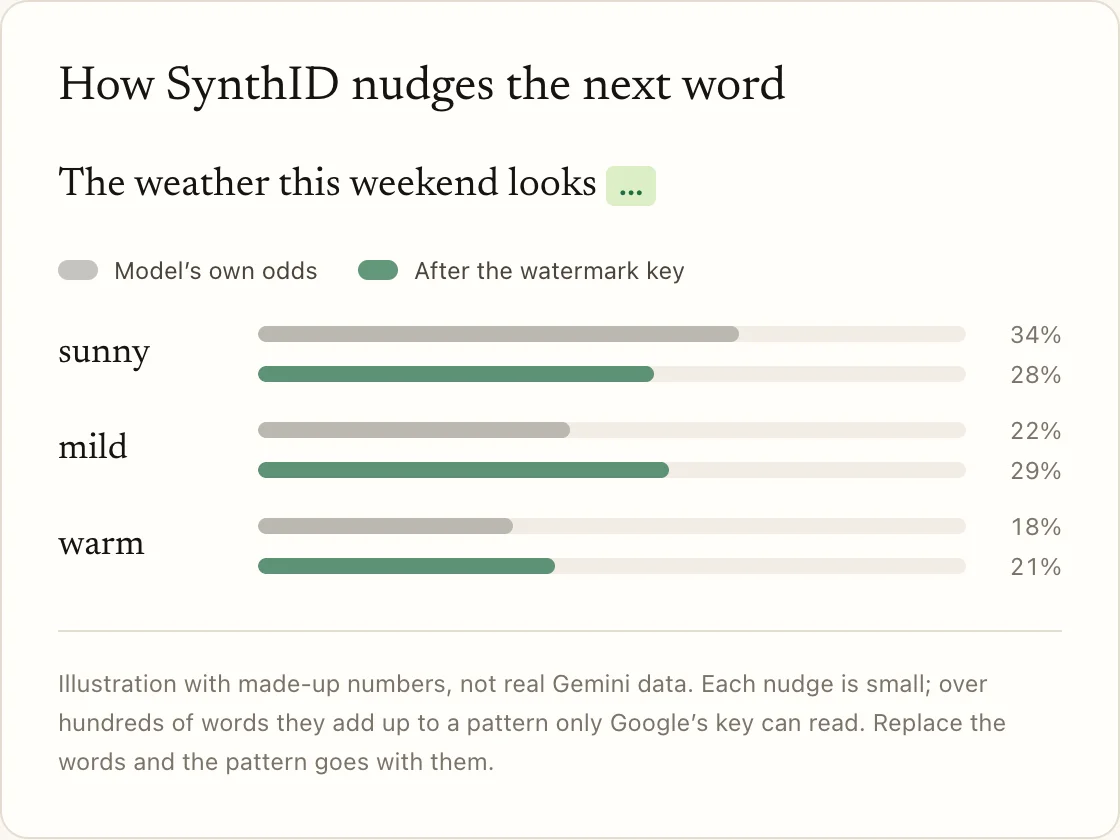
Instead, it works on the words. As Google DeepMind describes it, a language model assigns every possible next word a probability score. SynthID adjusts those scores slightly, using a secret key, so that over a passage the chosen words form a pattern. The text reads the same, and the pattern is invisible, but a detector that holds the key can score how closely a passage matches it.
Google tested this live before writing about it. In the Nature paper published in October 2024, Google DeepMind reported a trial on nearly 20 million Gemini responses and found no meaningful difference in how users rated watermarked and unwatermarked answers.
| Where you use Gemini | Watermarked? |
|---|---|
| Gemini app (mobile) | Yes, since May 2024 |
| Gemini on the web | Yes, since May 2024 |
| Gemini API | Not clearly stated by Google |
Google's announcement names the Gemini app and web experience. It does not mention the API, and answers from Google staff on the developer forum have been inconsistent. Until Google says it plainly, treat API text as unconfirmed either way.
Google has also signed up, along with Anthropic, Meta, Microsoft and OpenAI, to the EU's code of practice on marking AI-generated content under the EU AI Act. Both Claude and ChatGPT introduced text watermarks in 2026; Gemini's is the oldest of the three.
Google's May 2024 post lists the limits itself:
The common thread is room for choice. The watermark lives in the choices the model made between good alternatives. Remove those choices, by replacing the words or by asking a question with only one possible answer, and the pattern goes with them.
This also explains what does not weaken it. SynthID is not made of hidden characters, so tools that strip zero-width spaces or swap punctuation leave it untouched. Light edits leave most of the original word choices in place. A full rewrite in new words, which is what a humanizer does, replaces most of them.
Not today, and not for lack of tools:
So if someone says they found a Gemini watermark in your text, ask how. Only Google can run that check on Gemini output.
Google's own framing is that SynthID "isn't a silver bullet" for identifying AI content. A detected mark is good evidence that Gemini produced a passage. A missing one proves little: the text may be short, factual, edited, translated, or written by a model that does not use SynthID.
If you want the rewrite done for you, the Gemini Watermark Remover runs our humanizer on Gemini text: it rewrites every sentence in new words, then checks the result against your draft and flags any number, name or citation that changed. You can try it on the page without an account.
Google has watermarked Gemini app and web text with SynthID since May 2024; whether API text is marked is not clearly stated. The mark is a pattern in the word choices, invisible to readers and impossible to check for yourself, because Gemini's keys are not public. Google says thorough rewriting or translation greatly reduces it, and that it is weaker on short and factual answers. Stripping characters does nothing.
RealWrite Editorial Team
The RealWrite editorial team writes about AI detection, editing and how to keep your own voice when you draft with AI. We test what we write about on real drafts before we publish it.
AI detection
Claude now puts an invisible watermark in the text it writes. Here is what Anthropic has said about it, what it hasn’t, and why deleting characters does nothing.
6 min read
AI detection
OpenAI’s textGrain watermark is coming to ChatGPT and Codex in the EU. Here is where it applies, how it works, and how much editing it takes to fade.
4 min read
AI detection
Turnitin is the AI checker most students actually face. Here is what its report shows, what it does not, and how to read a score sensibly.
6 min read