New
A new look
A calmer, easier to read design across the site and your dashboard.
OpenAI’s textGrain watermark is coming to ChatGPT and Codex in the EU. Here is where it applies, how it works, and how much editing it takes to fade.
By RealWrite Editorial Team4 min read
Yes, in the EU. On 5 October 2026 OpenAI announced that it will add an invisible watermark, called textGrain, to ChatGPT and Codex text in the European Union, rolling out over the following weeks, and API developers can switch it on. The mark lives in the model's word choices, not in hidden characters, and OpenAI's own tests show that it fades quickly as the wording changes.
This article covers where the watermark applies, how textGrain works, what OpenAI's numbers say about editing, and what it means if you write with ChatGPT.
OpenAI's announcement, as reported by TechCrunch and BleepingComputer, has three parts:
The reason is the EU AI Act. Its transparency rules took effect on 2 August 2026 and require AI-generated content to be marked so that other systems can recognise it. About two months earlier, Anthropic had already started watermarking Claude's text, worldwide rather than only in the EU.
OpenAI has had a text watermark for a while. The Wall Street Journal reported in 2024 that the company had built one but held back, partly over fears that users would move to competitors that did not watermark.
| Where you use it | Watermarked? |
|---|---|
| ChatGPT in the EU | Yes, rolling out from October 2026 |
| Codex in the EU | Yes, rolling out from October 2026 |
| OpenAI API, anywhere | Only if the developer opts in |
"Eligible" output is OpenAI's word. It has not listed exactly which responses count, and very short answers are hard to mark in a detectable way anyway.
textGrain is a statistical watermark. OpenAI published a technical report describing it; in short:
The detector needs only the text and the key. It doesn't need to know who wrote the text or which conversation it came from, and OpenAI says the watermark does not identify the user.
Because the mark is in the choice of words, it survives copy and paste. That also means it does not depend on hidden characters, invisible spaces or unusual punctuation, which is why "watermark removers" that strip those characters do nothing to it.
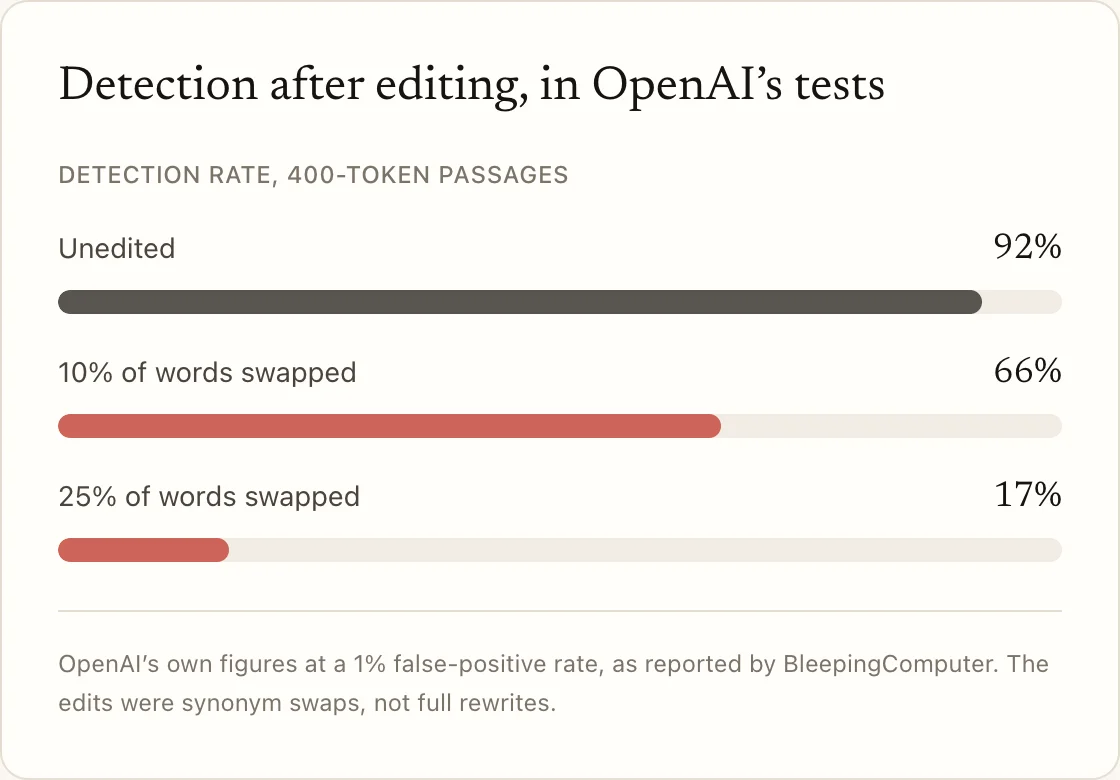
This is the part most people are looking for, and OpenAI was unusually open about it. Its figures, at a 1% false-positive rate:
| Text | Detection rate |
|---|---|
| Unedited, 400-token passage | about 92–95% |
| Unedited, 200-token passage | about 80% |
| 10% of words replaced with synonyms | about 66% |
| 25% of words replaced with synonyms | about 17% |
Short passages, math answers and translated text were all harder to detect, even before any editing.
Two things stand out. First, length matters: a short reply carries fewer nudges, so there is less pattern to find. Second, the mark fades fast. Replacing a quarter of the words, with simple synonym swaps rather than real rewriting, already brought detection below one in five.
That makes sense given the design. Every replaced word removes one nudge and adds a word the key never influenced. Rewrite every sentence in new words and a new structure, which is what a humanizer does, and there is very little of the original pattern left to find. Still, nobody outside OpenAI's approved testers can run the detector, so no tool can honestly promise the mark is gone.
OpenAI drew the limits clearly:
So if someone tells you a ChatGPT watermark was found in your work, it is worth asking how. The detector is not public. What most teachers and editors use is an ordinary AI detector, which estimates from writing style and makes mistakes, including on text people wrote themselves.
If you want the rewrite done for you, the ChatGPT Watermark Remover runs our humanizer on ChatGPT text: it rewrites every sentence in new words, then checks the result against your draft and flags any number, name or citation that changed. You can try it on the page without an account.
OpenAI is adding an invisible watermark, textGrain, to ChatGPT and Codex text in the EU from October 2026, and API developers can opt in. It lives in the word choices, so stripping characters does nothing. OpenAI's own tests show it fades quickly with editing: a quarter of the words swapped for synonyms brought detection down to about 17%. The detector is not public.
RealWrite Editorial Team
The RealWrite editorial team writes about AI detection, editing and how to keep your own voice when you draft with AI. We test what we write about on real drafts before we publish it.
AI detection
Claude now puts an invisible watermark in the text it writes. Here is what Anthropic has said about it, what it hasn’t, and why deleting characters does nothing.
6 min read
AI detection
Google has watermarked Gemini app text with SynthID since 2024. Here is how it works, what Google itself says weakens it, and what you can and can’t check.
4 min read
AI detection
Turnitin is the AI checker most students actually face. Here is what its report shows, what it does not, and how to read a score sensibly.
6 min read