New
A new look
A calmer, easier to read design across the site and your dashboard.
Claude now puts an invisible watermark in the text it writes. Here is what Anthropic has said about it, what it hasn’t, and why deleting characters does nothing.
By RealWrite Editorial Team6 min read
Yes. Since August 2026, Claude puts an invisible watermark in the text it writes. Anthropic announced it in a support article, "How Claude marks AI-generated content", as part of its commitments under the EU AI Act. The mark is built into the model's output, it does not change how the text reads, and Anthropic says it survives copy and paste and may survive some editing. What Anthropic has not said is how it works or how much editing it takes to remove it.
This article sets out what is known, what is not, and what it means if you write with Claude.
Anthropic's support article describes two kinds of marking:
Models launched on or after 2 August 2026 support marking from launch. Anthropic says it is adding marking to older models over time, so for a while some Claude text will carry the mark and some will not.
The timing is not a coincidence. The EU AI Act's transparency rules took effect on 2 August 2026, and they require providers to mark AI-generated content so that other systems can recognise it. Anthropic, Google, Meta, Microsoft and OpenAI have all signed up to the EU's code of practice on marking AI-generated content, according to TechCrunch.
Anthropic says the watermark is applied at the model level. In practice that means it does not matter how you reach Claude:
Anthropic notes that the signed file metadata may not be available on every cloud platform, but the text watermark comes from the model itself, so it is not tied to a region. OpenAI has since announced a watermark for ChatGPT too.
Anthropic has not published the method. Its own description is short: the mark is invisible, it is built into the output, and it does not change readability. Daring Fireball's headline summed up the reaction: Anthropic posted "How Claude marks AI-generated content" without explaining how Claude marks AI-generated content.
What we can say is how text watermarks of this kind generally work. While the model writes, a secret key slightly tilts which word it picks next among several good options. One nudge means nothing. Hundreds of them, across a passage, add up to a statistical pattern that a detector holding the same key can measure. Google's SynthID for text and OpenAI's textGrain both work this way. It is likely that Anthropic's works along similar lines, since it is the standard way to make a mark that survives copy and paste, but that is an informed guess, not something Anthropic has confirmed. Researchers remain sceptical about how much any of these marks will achieve.
Two things follow from this design, and both match what Anthropic has said:
Before the announcement, a whole category of "watermark remover" tools sprang up around a different idea: that AI text hides invisible Unicode characters, such as zero-width spaces, non-breaking spaces or soft hyphens. These tools strip those characters, or swap em dashes for commas, and call the text clean.
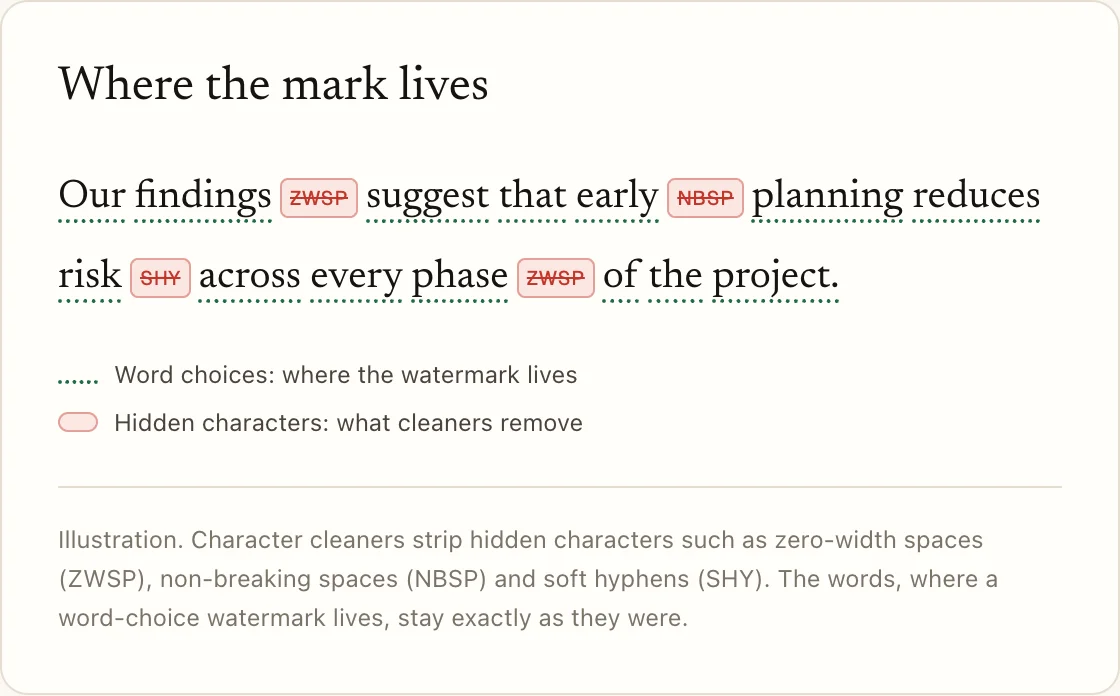
That approach does nothing to a watermark like Claude's.
If the words stay, the pattern stays.
Anthropic has not published any numbers. All it says is that the mark may persist through some editing. TechCrunch asked how much editing removes it and reported no answer.
The closest public evidence comes from OpenAI, which tested its own word-choice watermark. Replacing 10% of the words with synonyms cut detection on 400-token passages from about 92% to 66%; replacing 25% cut it to 17%. Claude's watermark is a different system with different settings, so those figures do not transfer directly. They do show the general shape: a watermark that lives in word choices fades as the word choices change.
So, in rough order of how much they change:
| Change | Effect on the wording |
|---|---|
| Removing hidden characters or em dashes | None. Every word stays. |
| Fixing a few words or a sentence | Small. Most of the original word choices remain. |
| Rewriting every sentence in new words | Large. Few of the original word choices remain. |
| Translating into another language | Large. Every word is different. |
A humanizer sits in the third row. It rewrites each sentence with different words and a different structure while keeping what the text says. Nobody outside Anthropic can confirm what that does to the mark, because there is no public checker, so treat any tool that promises "100% removal" with suspicion.
Anthropic is careful about this, and it matters if you are on either side of an accusation.
There is also no way, today, for a teacher or an employer to check for the mark themselves. If someone says their tool detected a Claude watermark, ask which tool, because Anthropic has not released one to the public. What they most likely ran is an ordinary AI detector, which guesses from style and is often wrong.
A few practical points:
If you want the rewrite done for you, the Claude Watermark Remover runs our humanizer on Claude text: it rewrites every sentence in new words, then checks the result against your draft and flags any number, name or citation that changed. You can try it on the page without an account.
Claude has watermarked its text since August 2026, everywhere and on every Claude product, as part of Anthropic's EU AI Act commitments. The mark lives in the word choices, so stripping characters does nothing and only changing the wording can weaken it. Anthropic has not published how it works, how much editing removes it, or a public way to check for it.
RealWrite Editorial Team
The RealWrite editorial team writes about AI detection, editing and how to keep your own voice when you draft with AI. We test what we write about on real drafts before we publish it.
AI detection
OpenAI’s textGrain watermark is coming to ChatGPT and Codex in the EU. Here is where it applies, how it works, and how much editing it takes to fade.
4 min read
AI detection
Google has watermarked Gemini app text with SynthID since 2024. Here is how it works, what Google itself says weakens it, and what you can and can’t check.
4 min read
AI detection
Turnitin is the AI checker most students actually face. Here is what its report shows, what it does not, and how to read a score sensibly.
6 min read